Unlocking the Future with Sealing Technology: The Next Evolution of Sealing Solutions
NOK and EAGLE Industry have a long history together. EAGLE Industry began in 1964, when NOK’s mechanical seal division was spun off and became a separate company. Since then, the two companies have taken different approaches to sealing technology, each building its own expertise. On October 1, 2026, they came together again through a business integration. Now, they are combining their strengths to explore what comes next in sealing.
Two Sealing Technologies with More Than Half a Century of Proven Performance
Oil seals are one of NOK’s core products, while EAGLE Industry offers mechanical seals. Both are cylindrical components fitted around rotating shafts to prevent liquids and gases from leaking out and dust and other contaminants from getting in. But they are quite different in how they work and where they are used.
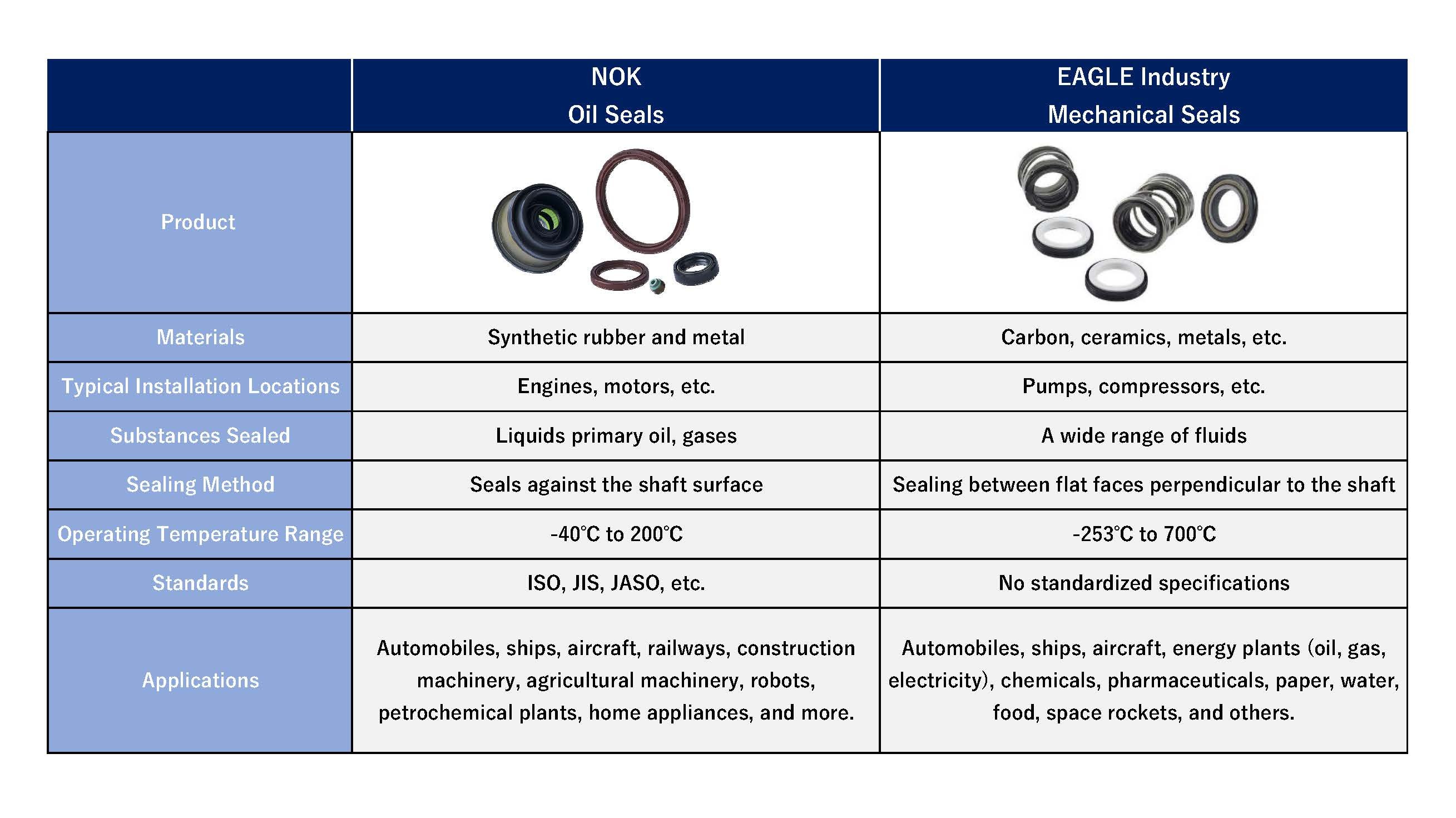
As the name suggests, oil seals are mainly used to keep oil and other fluids contained. They use the elasticity of rubber to fit closely around a rotating shaft and create a seal. Their materials, pressure ranges, and other specifications are defined by standards such as Japanese Industrial Standards (JIS). This makes it possible to produce large volumes of consistent, high-quality products, sometimes tens or hundreds of thousands at a time. Oil seals are widely used in automobiles, other forms of mobility, and industrial machinery. Their strength lies in refining standardized products to a very high level.
Mechanical seals take a different approach. Instead of sealing around the shaft, they seal fluid between two flat faces positioned perpendicular to it.Many are designed from scratch for a specific customer or application. Production can range from just a few units to hundreds of thousands.Mechanical seals can also handle conditions that are difficult for rubber seals. These include extremely high pressure, very high rotational speeds, extreme temperatures, and slurries containing solid particles such as soil or sand. This makes them suitable for an exceptionally wide range of applications: from vehicles and industrial machinery to energy plants, ships, deep-sea exploration vessels, and even space rockets.
Precision Manufacturing and Dependable After-Sales Support
Mechanical seals work by bringing two extremely smooth sealing faces very close together. A tiny amount of the fluid being sealed enters the gap between them, forming a thin film that provides lubrication while maintaining the seal. The challenge is controlling that gap precisely. If it is too narrow, friction increases and can cause failure. If it is too wide, more fluid can leak through. The gap therefore has to be controlled with submicron precision: one micron is just 0.001 millimeters.
The materials must also be carefully selected based on properties of the fluid being sealed, such as its viscosity, volatility, and corrosiveness. Engineers then precisely design parameters such as the width of the gap and the spring force to ensure reliable sealing performance. The sealing faces are made from extremely hard materials such as SiC (silicon carbide), which is close to diamond in hardness. They are then finished to an exceptionally high degree of flatness. The difference in height across the surface must be less than one micron.
To put that level of precision into perspective, imagine scaling a palm-sized mechanical seal up to a circle 200 meters in diameter. Even at that size, the difference in height across the surface would be less than one millimeter.
But EAGLE Industry’s work does not end when the product is delivered. Its after-sales support can continue for years, and in some cases for decades. Mechanical seals are used in energy plants, industrial machinery, and other equipment that society depends on. Even a single day of downtime can have a significant impact. Once a seal has proven that it can operate reliably, it is therefore usually repaired or replaced without changing the original specifications.
During scheduled inspections, the mechanical seal is removed and returned to the factory, where it is disassembled and cleaned. Any necessary repairs and parts replacements are then carried out before the seal is reinstalled. This combination of advanced engineering and long-term support helps EAGLE Industry maintain product quality and build lasting trust with its customers.
Bringing Two Sealing Technologies Together to Open Up New Possibilities
Through the development and manufacture of oil seals, NOK has built extensive expertise in organic materials such as rubber and resins. EAGLE Industry, meanwhile, has led the market as a comprehensive manufacturer of mechanical seals made from inorganic materials such as carbon, ceramics, and metals. By combining the strengths that each company has continued to develop, they have established a framework for delivering comprehensive sealing solutions with a breadth and depth rarely seen anywhere in the world.
Bringing together the sealing expertise they have developed over decades, the two companies aim to make an even broader and deeper contribution to safety and comfort throughout society.
Our new challenge begins now.